In an era where businesses depend on uninterrupted connectivity, network infrastructure has become the backbone of digital operations. From cloud applications and remote workforces to IoT devices and data centers, everything relies on a stable and high-performing network. That’s why a reliable network management system has become a non-negotiable part of enterprise IT.
However, as networks grow more complex, traditional monitoring approaches fall short. Organizations can no longer rely on reactive troubleshooting — they need real-time visibility, predictive insights, and automated response mechanisms. This is where a Network Management System (NMS) plays a critical role.
This in-depth guide explores everything about NMS — from its fundamentals and architecture to features, use cases, deployment models, implementation strategies, and future trends — helping you understand how to build a resilient, high-performing network environment.
Modern networks are no longer simple. They are:
- Distributed across multiple locations
- Connected through hybrid and multi-cloud environments
- Supporting thousands of devices and users
- Handling massive volumes of real-time data
Without proper oversight, even a minor issue can escalate into a major outage. That’s why organizations rely on a network management system to maintain visibility, control, and performance.
What is a Network Management System (NMS)?
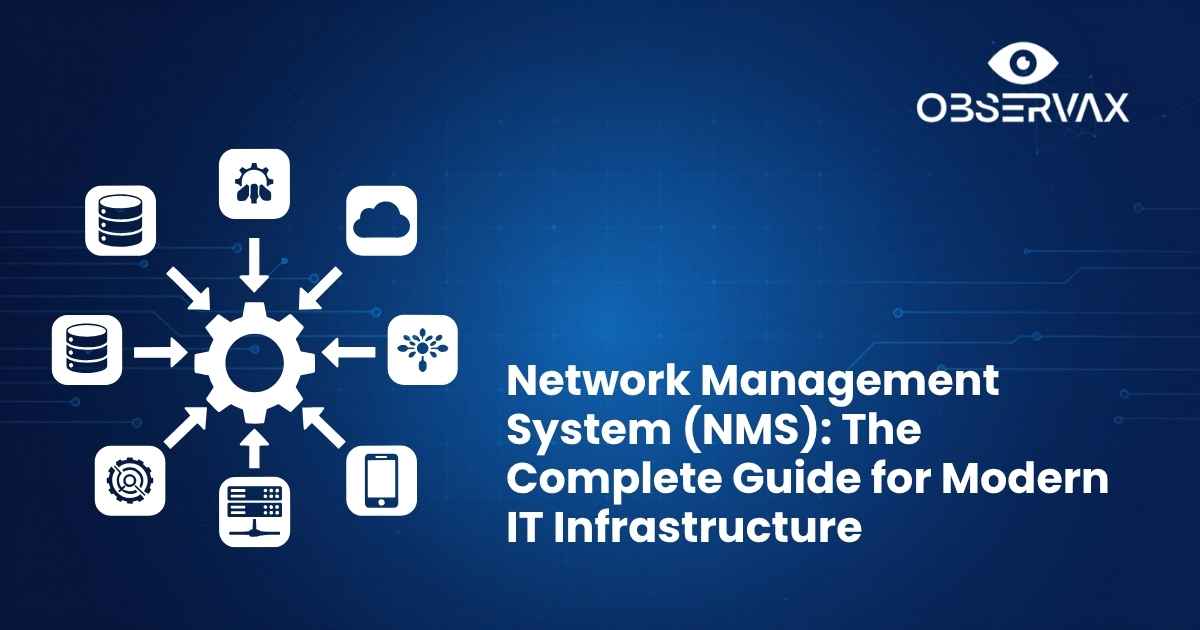
A Network Management System (NMS) is a centralized platform designed to monitor, manage, and optimize network infrastructure. It continuously tracks the health, availability, and performance of network devices such as routers, switches, firewalls, servers, and endpoints.
Unlike basic monitoring tools, a modern network management system provides deep visibility across the entire network ecosystem, enabling IT teams to detect anomalies, diagnose issues, and ensure uninterrupted service delivery.
Core Objectives of an NMS:
- Ensure network uptime and availability
- Detect and resolve issues before users are impacted
- Provide end-to-end visibility across infrastructure
- Optimize network performance and resource utilization
- Support capacity planning and scalability
An effective NMS transforms IT operations from reactive firefighting into proactive network management.
NMS vs. Network Monitoring — Are They the Same Thing?
Not quite — and the distinction matters. Network monitoring refers to the ongoing activity of observing network performance and availability: watching metrics, catching downtime, logging events. A network management system, on the other hand, is the broader platform that performs that monitoring and adds control, configuration, automation, and reporting capabilities on top of it.
In practice, every NMS includes network monitoring as one of its core functions — but an NMS is the complete system, while monitoring is just one layer of what it does. Think of monitoring as the eyes, and the NMS as the eyes, hands, and brain working together.
NMS Market Trends and Evolution in 2026
- AI-driven monitoring (AIOps integration) — Systems can now predict failures before they occur.
- Cloud-native NMS solutions — Designed for scalability and flexibility.
- Integration with observability platforms — Combining logs, metrics, and traces.
- Shift from monitoring to experience management — Focus on end-user experience rather than just uptime.
- Automation-first approach — Reducing manual intervention and human error.
Organizations are moving from siloed tools to unified monitoring ecosystems.
How Network Management Systems Work: Core Functional Layers
An NMS works by collecting data from network devices, analyzing it, and presenting actionable insights through dashboards and alerts.
1. Device Discovery & Network Mapping
Automatically scans and identifies all connected devices, creating a dynamic topology map that shows how components interact.
2. Data Collection (Protocols & Telemetry)
Gathers performance data using protocols such as:
- SNMP (Simple Network Management Protocol)
- NetFlow / sFlow
- ICMP (Ping checks)
- WMI / APIs
3. Performance Monitoring
Tracks critical metrics like:
- Bandwidth usage
- Latency
- Packet loss
- CPU & memory utilization
4. Fault Detection & Event Management
Detects failures such as device downtime, link failures, and configuration issues.
5. Intelligent Alerting
Generates alerts based on thresholds and anomalies via email/SMS, dashboard notifications, and escalation workflows.
6. Visualization & Dashboards
Real-time dashboards, heatmaps, and network topology views.
7. Reporting & Analytics
Generates reports for SLA compliance, capacity planning, and performance trends.
Key Benefits of NMS Solutions
Operational Benefits:
- Proactive Issue Detection — Identify anomalies before they escalate into outages.
- Faster Troubleshooting — Reduce mean time to resolution (MTTR).
- Centralized Monitoring — Manage the entire network from a single interface.
- Improved Resource Utilization — Optimize bandwidth and infrastructure usage.
Business Benefits:
- Reduced Downtime Costs — Prevent revenue loss from outages.
- Enhanced User Experience — Ensure consistent application performance.
- Better Decision-Making — Data-driven insights for IT strategy.
- Scalability Support — Easily adapt to growing network demands.
Essential NMS Features
A modern network management system is designed to handle the growing complexity of enterprise networks, spanning on-premises infrastructure, cloud environments, and remote endpoints.
Key Features:
- Real-Time Network Monitoring — Continuously tracks device and service health.
- Automated Device Discovery — Identifies and maps connected devices without manual configuration.
- Network Topology Mapping — Visual representation of network architecture and dependencies.
- Bandwidth & Traffic Analysis — Detects congestion, bottlenecks, and unusual usage patterns.
- Fault & Event Management — Detects failures and logs events for faster troubleshooting.
- Root Cause Analysis (RCA) — Identifies underlying causes rather than just symptoms.
- Intelligent Alerting & Escalation — Real-time, threshold-based alerts with automatic escalation.
- Multi-Vendor Device Support — Compatibility across diverse hardware and software.
- Cloud & Hybrid Network Monitoring — Extends visibility across cloud and hybrid infrastructure.
- API Integrations — Seamless integration with ITSM, automation, and third-party platforms.
- Customizable Dashboards — Personalized views by role, priority, and KPI.
- SLA & Compliance Monitoring — Tracks performance against SLAs and regulatory requirements.
- Historical Data & Trend Analysis — Supports capacity planning and forecasting.
- Basic Security Monitoring — Detects unusual behavior indicating potential threats.
- Scalability & High Availability — Grows with the network while maintaining performance.
On-Premises vs. Cloud-Based NMS: Which Deployment Model Fits Your Environment?
Choosing how your network management system is deployed matters just as much as choosing which features it has. The three common models:
On-Premises NMS
Installed and run on your own infrastructure, giving full control over data, configuration, and security — a common requirement for regulated industries, government, and air-gapped or highly sensitive networks. Trade-off: your team owns the maintenance, updates, and scaling.
Cloud-Based / SaaS NMS
Hosted and maintained by the vendor, accessed via a web browser. Faster to deploy, easier to scale, and lower upfront infrastructure cost — a strong fit for distributed teams and organizations that want to avoid managing the monitoring stack itself.
Hybrid NMS
Combines both — on-prem components for sensitive or latency-critical segments, cloud components for scalability and remote visibility. Increasingly common as enterprises operate across data centers, multi-cloud, and edge locations simultaneously.
Which one fits? If your environment includes air-gapped, OT/SCADA, or heavily regulated segments, on-prem or hybrid is usually the right call. If your priority is fast deployment and minimal infrastructure overhead, a cloud-native NMS gets you there quickest.
NMS vs. Other IT Monitoring Solutions
1. NMS vs. ITSM
- NMS → Focuses on network health and performance
- ITSM → Focuses on service workflows and ticketing
2. NMS vs. APM
- NMS → Infrastructure-level monitoring
- APM → Application-level monitoring
3. NMS vs. SIEM
- NMS → Performance & availability
- SIEM → Security & threat detection
Common NMS Use Cases
Enterprise Use Cases:
- Monitoring corporate network infrastructure
- Managing remote workforce connectivity
- Ensuring uptime for business-critical applications
Data Center Use Cases:
- Tracking server and switch performance
- Managing bandwidth usage
- Detecting hardware failures
Cloud & Hybrid Environments:
- Monitoring cloud workloads
- Ensuring seamless hybrid connectivity
- Tracking application performance across regions
Telecom & ISP:
- Monitoring large-scale networks
- Managing service delivery
- Ensuring SLA compliance
NMS Implementation Best Practices
Implementing a network management system requires a clear strategy aligned with business and operational goals. Organizations should begin by identifying critical network components and defining what needs to be monitored. Proper configuration of alert thresholds is essential to avoid unnecessary noise while still capturing real issues. Integrating the NMS with ITSM tools further streamlines incident management and improves response times.
Best Practices:
- Define clear monitoring objectives
- Identify critical network components
- Set realistic alert thresholds
- Avoid alert fatigue with smart filtering
- Integrate with ITSM for incident management
- Use automation for repetitive tasks
- Continuously review and optimize configurations
The Future of NMS Technology
The future of network management systems is centered around intelligence, automation, and scalability. With the rise of AIOps, NMS platforms are evolving to predict issues before they occur, reducing downtime and manual effort.
Emerging Trends:
- AIOps & Predictive Monitoring — Detect issues before they occur
- Self-Healing Networks — Automated issue resolution
- Full Observability Platforms — Unified view across systems
- User Experience Monitoring — Focus on end-user satisfaction
- Cloud-first Monitoring Solutions — Designed for scalability and agility
Choosing the Right NMS Solution
Selecting the right network management solution depends on organizational needs, environment, and growth plans.
Key Considerations:
- Scalability for future growth
- Ease of deployment and use
- Integration capabilities
- Real-time monitoring features
- Deployment model fit (on-prem, cloud, or hybrid)
- Customization and reporting
- Cost vs. value
A well-chosen NMS acts as a strategic asset, not just a monitoring tool.

In today’s digitally driven world, maintaining high network performance and availability is no longer optional — it’s essential. A network management system serves as a critical enabler for organizations to gain real-time visibility, detect issues proactively, and ensure seamless connectivity across increasingly complex environments.
A well-implemented NMS reduces downtime, improves operational efficiency, and empowers data-driven decision-making. By transitioning from reactive troubleshooting to proactive, predictive network management, businesses can stay ahead of disruptions and maintain a competitive edge.
Organizations that invest in modern, scalable, and intelligent NMS solutions will be better positioned to handle future challenges and drive digital transformation.
Frequently Asked Questions
What is NMS in networking?
What are the key components of a network management system?
How does an NMS work?
Is NMS the same as network monitoring?
What's the difference between an on-premises and cloud-based NMS?