Modern businesses manage thousands of assets across offices, data centers, warehouses, logistics operations, and field locations. Knowing what assets, you own is important, but knowing where they are, who is using them, what condition they are in, and how they move through their lifecycle is even more valuable. This is where asset tracking software helps. Instead of relying on spreadsheets, manual audits, and disconnected records, businesses can maintain a centralized view of their assets and their current status.
The result is better visibility, stronger accountability, fewer asset-related blind spots, and more informed operational decisions.
What Is Asset Tracking Software?
Asset tracking software is a digital solution that helps organizations identify, record, monitor, and manage assets throughout their lifecycle.
Depending on the environment, tracked information can include:
- Asset name, ID, and type
- Current location and ownership
- Asset status and availability
- Purchase and warranty information
- Maintenance history
- Movement and assignment records
- Lifecycle and retirement information
Modern asset tracking systems can use technologies such as barcodes, QR codes, RFID, GPS, network discovery, and connected devices to collect and update asset information.
How Asset Tracking Software Works
A typical asset tracking workflow follows a simple process:
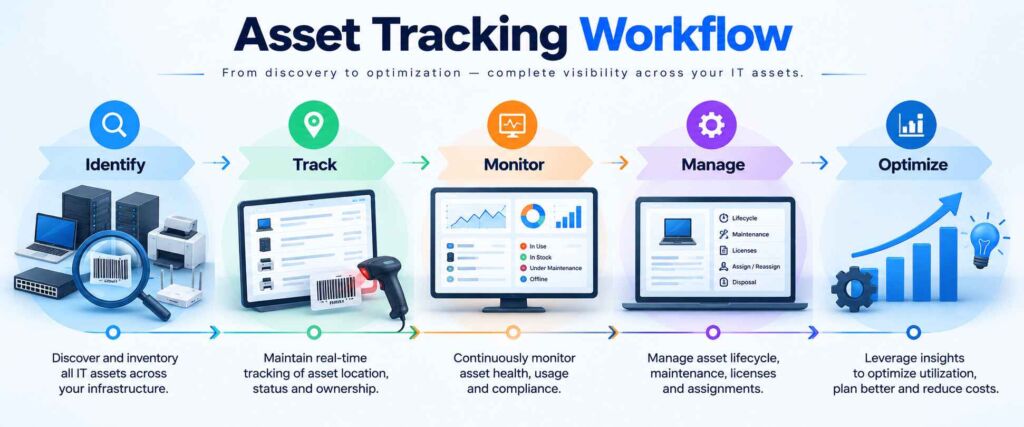
This creates a more reliable source of asset information and reduces dependence on manually maintained records.
Asset Tracking vs. Asset Management
Asset tracking primarily focuses on where an asset is and its current status. Asset management is broader and can include acquisition, ownership, maintenance, financial information, compliance, lifecycle planning, and retirement.
In practice, effective asset tracking forms an important part of broader asset management.
Why Businesses Need Modern Asset Tracking Software
Eliminating Manual Asset Records
Spreadsheets and manual registers can become difficult to maintain as organizations grow. Different teams may maintain separate records, creating duplicate, outdated, or missing information.
A centralized asset tracking system gives teams a consistent view of their assets and reduces manual data entry.
Improving Real-Time Asset Visibility
Organizations need to know more than simply what they own. They need visibility into asset location, ownership, status, and availability.
Real-time or regularly updated asset information helps teams respond faster and make better operational decisions.
Reducing Asset Loss and Misplacement
Untracked assets can easily become misplaced, underutilized, or difficult to recover. Clear ownership and location information improves accountability and makes it easier to identify missing or inactive assets.
Where Asset Tracking Software Is Used
Asset tracking is no longer limited to IT departments. Organizations across multiple industries can use it to improve asset visibility.
| Environment | Assets Tracked | Key Benefit |
| IT Infrastructure | Servers, laptops, switches, endpoints | Ownership and lifecycle visibility |
| Warehouses | Equipment, scanners, tools | Location and availability |
| Logistics | Vehicles, containers, equipment | Movement and accountability |
| Field Operations | Mobile equipment and devices | Location and utilization |
| Enterprise Operations | Machinery and infrastructure | Operational control |
IT Infrastructure
For IT teams, IT asset tracking can provide visibility into servers, endpoints, network devices, laptops, and other infrastructure. It can also help connect asset information with monitoring, service management, and configuration data.
Warehouses and Distribution Centers
Warehouse teams can track equipment, scanners, tools, and other operational assets. Better visibility can help reduce misplaced equipment and improve asset availability.
Logistics and Transportation
Logistics operations often involve assets moving between multiple locations. Tracking vehicles, containers, equipment, and other physical assets can improve accountability and operational visibility.
Enterprise and Field Operations
Organizations with distributed offices, field teams, or remote infrastructure can use asset tracking to maintain a consistent view of assets across locations.
Key Features of Asset Tracking Software
The right solution should provide more than a basic asset list. Important capabilities include:
Automated Asset Discovery
Automated discovery reduces manual inventory work and helps identify assets across connected environments.
Asset Location and Ownership Tracking
Teams should be able to quickly identify where an asset is, who is responsible for it, and what its current status is.
Asset Lifecycle Management
Tracking should continue from procurement and deployment through utilization, maintenance, upgrades, and retirement.
Reporting, Alerts, and Analytics
Dashboards and reports help teams identify missing assets, aging infrastructure, warranty concerns, lifecycle risks, and other operational issues.
How Asset Tracking Software Supports the Asset Lifecycle
Asset visibility becomes more valuable when it continues throughout the complete lifecycle:
Procurement → Deployment → Utilization → Maintenance → Upgrade → Retirement
From Procurement to Retirement
A centralized asset record can follow an asset from the moment it enters the organization until it is retired. This creates a historical record of ownership, usage, maintenance, and lifecycle status.
Using Asset Data for Better Decisions
Reliable asset data helps organizations identify aging assets, plan replacements, reduce unnecessary purchases, and improve resource utilization.
Asset Tracking for IT and Hybrid Infrastructure
Modern IT environments can span on-premises infrastructure, remote locations, cloud services, and virtual environments.
On-Premises and Network Assets
Asset tracking can provide visibility into servers, switches, endpoints, and other connected infrastructure.
Remote and Distributed Assets
Centralized tracking becomes especially valuable when assets are distributed across offices, branches, data centers, and remote locations.
Connecting Asset Data With CMDB
Connecting asset information with a configuration management database (CMDB) can provide additional context about relationships between assets, systems, and services.
Connecting Asset Tracking With IT Operations
Asset information becomes more useful when it is connected to other operational systems.
Asset Tracking and Network Monitoring
Combining asset information with network monitoring helps teams understand both what devices exist and how they are performing.
Asset Tracking and ITSM
Connecting asset data with IT service management can give support teams greater context when handling incidents, service requests, and changes.
Asset Tracking and CMDB
CMDB integration can connect assets with their configuration relationships and dependencies, creating a more complete operational view.
How ObservaX tbAssetManager Simplifies Asset Tracking
For organizations looking for centralized asset visibility, ObservaX tbAssetManager provides an enterprise-focused approach to asset management and governance.
Key capabilities include:
- Automated asset discovery
- Centralized asset inventory
- Ownership and depreciation tracking
- Warranty and audit information
- Barcode and QR-based physical validation
- End-to-end asset lifecycle visibility
- Asset risk management
- EOL and EOS visibility
- CMDB and relationship context
- Integration with other ObservaX capabilities
By bringing asset information into a centralized environment, tbAssetManager helps organizations move beyond static asset records toward connected asset intelligence and governance.
Final Verdict: Turn Asset Data Into Real-Time Visibility
As businesses expand across IT infrastructure, warehouses, logistics networks, and distributed operations, maintaining accurate asset information becomes increasingly important.
The right asset tracking software can bring location, ownership, status, and lifecycle information into one centralized view. This helps organizations reduce manual work, improve accountability, and make better operational decisions.
For IT-focused and enterprise environments, solutions such as ObservaX tbAssetManager can take asset visibility further by connecting asset intelligence with lifecycle management, CMDB context, monitoring, and IT operations.
FAQs About Asset Tracking Software
What is asset tracking software?
What types of assets can be tracked?
What is the difference between asset tracking and asset management?
Can asset tracking software track IT assets?
Can asset tracking software be used for warehouses and logistics?