Introduction
Enterprise IT support is evolving rapidly. As organizations embrace digital transformation, hybrid work, and cloud-based applications, IT service desks are expected to deliver faster resolutions, 24×7 support, and exceptional employee experiences, all while managing increasing ticket volumes and limited resources.
A significant percentage of IT support requests are repetitive, including password resets, software installation requests, VPN connectivity issues, access requests, and ticket status inquiries. While these tasks are essential, they consume valuable service desk resources that could otherwise be dedicated to resolving critical incidents and strategic initiatives.
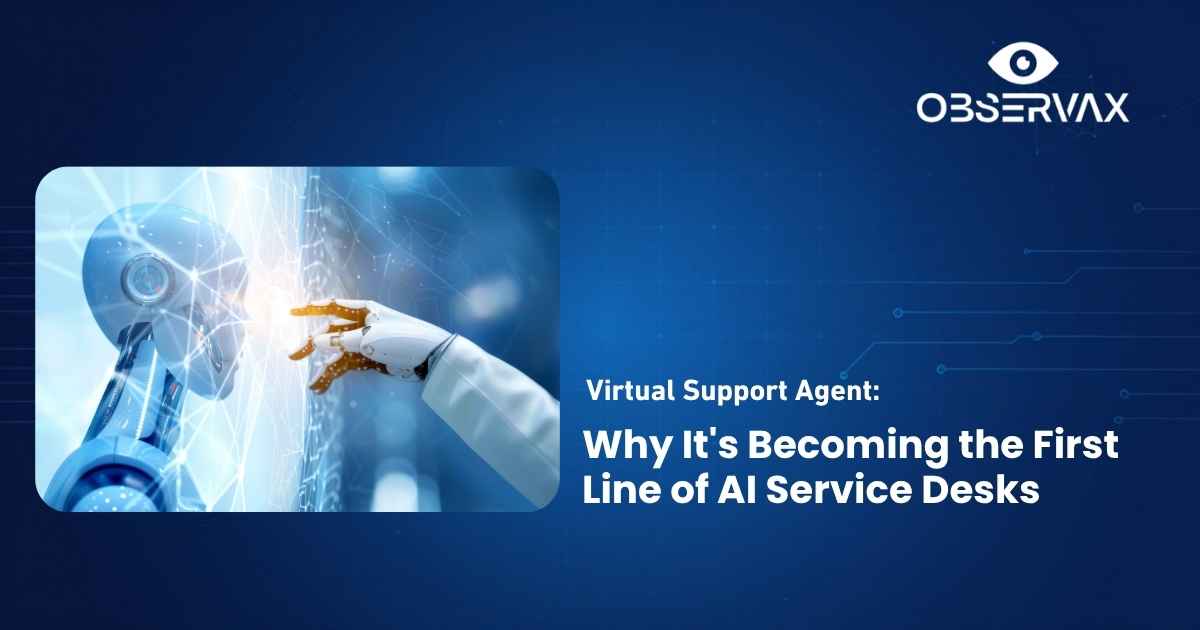
This is where Virtual Support Agents (VSAs) are transforming the modern AI service desk. Powered by Artificial Intelligence (AI), Natural Language Processing (NLP), and workflow automation, virtual support agents provide instant assistance, automate routine IT tasks, and seamlessly connect employees with the right support resources.
Rather than replacing human service desk analysts, virtual support agents enhance service delivery by handling repetitive Level-1 support requests while enabling IT teams to focus on complex issues that require technical expertise.
As AI continues to reshape enterprise IT operations, virtual support agents are becoming one of the most valuable capabilities within today’s intelligent service desk.
What Is a Virtual Support Agent?
A Virtual Support Agent is an AI-powered digital assistant that interacts with employees through chat, self-service portals, collaboration platforms, mobile applications, or enterprise communication channels to provide IT support using natural language conversations.
Unlike traditional chatbots that rely on predefined scripts and keyword-based responses, modern virtual support agents understand user intent, interpret conversational context, and automate IT service workflows.
A virtual support agent can help employees:
- Reset passwords
- Unlock user accounts
- Submit service requests
- Track ticket status
- Troubleshoot common IT issues
- Recommend relevant knowledge articles
- Create or update incidents
- Escalate complex requests to the appropriate support team
Because they are integrated with an AI service desk, virtual support agents can do much more than answer frequently asked questions,they actively participate in IT service delivery by executing workflows, retrieving information, and improving response times.
Why Virtual Support Agents Are Becoming the First Line of AI Service Desks
Organizations are increasingly positioning virtual support agents as the first point of contact for IT support. This shift is driven by changing business requirements, employee expectations, and advances in AI technology.
Growing Support Demand
Modern enterprises rely on hundreds of business applications, cloud platforms, and connected devices. As digital workplaces expand, service desks receive significantly more requests than ever before.
Scaling support simply by hiring more analysts is costly and difficult. Virtual support agents help organizations manage increasing ticket volumes by automating repetitive service requests and enabling employees to resolve common issues independently.
Employees Expect Instant Support
Today’s employees expect IT support to be as responsive as the consumer applications they use every day. Waiting in long queues for routine issues no longer aligns with modern workplace expectations.
Virtual support agents provide immediate assistance through conversational interfaces, allowing employees to receive support anytime, from anywhere. Whether it’s checking the status of an incident or requesting software access, users receive quick and consistent responses without waiting for a human agent.
AI Has Made Service Desks Smarter
Earlier generations of chatbots were limited to predefined rules and keyword matching, often leading to frustrating user experiences.
Modern virtual support agents leverage AI and NLP to understand conversational language, recognize intent, and deliver context-aware responses.
For example, whether an employee says:
- “I can’t log in.”
- “My password isn’t working.”
- “I need help accessing my account.”
The virtual support agent recognizes that all three requests relate to an authentication issue and initiates the appropriate workflow automatically.
This ability to understand intent makes virtual support agents a key capability of today’s intelligent AI service desk.
Also Read: The Future of AI IT Service Management: 5 Trends Defining 2026
How Does a Virtual Support Agent Work?
A virtual support agent combines conversational AI with IT Service Management (ITSM) processes to automate support while maintaining a seamless employee experience.
| Step | How the Virtual Support Agent Responds |
| Understand the Request | Uses AI and Natural Language Processing (NLP) to interpret the employee’s issue. |
| Identify User Intent | Determines whether the request is related to an incident, service request, knowledge article, or account issue. |
| Retrieve or Execute | Searches the knowledge base or initiates an automated workflow to resolve the request. |
| Resolve or Escalate | Automatically resolves routine requests or transfers complex issues to the appropriate service desk analyst with complete context. |
By automating these repetitive processes, virtual support agents reduce manual effort while improving service quality and response times.
Key Benefits of Virtual Support Agents
Organizations implementing virtual support agents as part of their AI service desk strategy experience measurable improvements in service efficiency, employee satisfaction, and operational performance.
Faster Resolution Times
Routine IT requests no longer need to wait in a service desk queue. Virtual support agents can instantly resolve common issues such as password resets, software requests, and account unlocks by executing predefined workflows and accessing relevant knowledge articles.
This significantly reduces response times while improving overall service desk productivity.
Improved Employee Experience
Employees want quick and convenient support, regardless of where they work or what time they need assistance.
Virtual support agents provide:
- 24×7 availability
- Instant responses
- Self-service convenience
- Personalized interactions
- Consistent support across channels
When a request cannot be resolved automatically, the virtual support agent transfers it to a service desk analyst along with the complete conversation history, eliminating the need for employees to repeat their issue.
Reduced Service Desk Workload
Many IT service desks spend a large portion of their time handling repetitive Level-1 support requests.
By automating routine tasks, virtual support agents reduce ticket volumes reaching human analysts, allowing IT teams to focus on higher-priority incidents, problem management, and strategic IT initiatives.
Better Operational Efficiency
Virtual support agents improve operational efficiency by integrating directly with ITSM workflows. They can automatically create incidents, update service requests, retrieve knowledge articles, and trigger approval processes without manual intervention.
This streamlines service delivery while helping organizations maintain consistent service quality.
Scalable IT Support
Unlike traditional support models that require additional staff as demand grows, virtual support agents can handle thousands of simultaneous conversations. This makes them ideal for organizations with distributed workforces, seasonal demand, or rapid business growth.
Virtual Support Agent vs. Traditional Chatbot
Although both technologies provide conversational interfaces, modern virtual support agents deliver significantly more value than traditional chatbots.
| Traditional Chatbot | AI-Powered Virtual Support Agent |
| Rule-based conversations | AI-powered conversational interactions |
| Keyword matching | Natural Language Processing (NLP) and intent recognition |
| Limited FAQ responses | Context-aware support and workflow automation |
| Static responses | Personalized recommendations based on user context |
| Basic ticket creation | Intelligent ticket routing and automated request fulfillment |
| Limited escalation | Seamless escalation with complete conversation history |
Rather than simply answering frequently asked questions, virtual support agents actively participate in IT service delivery, making them an essential capability of a modern AI service desk.
Best Practices for Deploying a Virtual Support Agent
Successfully implementing a virtual support agent requires more than deploying conversational AI. Organizations should integrate the solution into their broader ITSM strategy to maximize value.
Consider the following best practices:
- Start with high-volume use cases: Begin by automating repetitive requests such as password resets, account unlocks, software provisioning, and ticket status inquiries.
- Maintain an accurate knowledge base: AI performs best when supported by up-to-date documentation, FAQs, and knowledge articles.
- Integrate with ITSM workflows: Connect the virtual support agent with incident management, service requests, approvals, and knowledge management to enable end-to-end automation.
- Enable seamless human escalation: Complex issues should be transferred to service desk analysts with complete conversation history and context to ensure faster resolution.
- Measure performance continuously: Monitor KPIs such as ticket deflection rate, Mean Time to Resolution (MTTR), SLA compliance, first-contact resolution, and employee satisfaction to identify improvement opportunities.
A phased implementation approach helps organizations increase adoption while delivering measurable business outcomes.
Conclusion
The role of the IT service desk is changing. Employees expect instant, personalized support, while organizations need to manage increasing service demands without significantly expanding their support teams.
Virtual support agents address both challenges by combining conversational AI, intelligent automation, and ITSM workflows to resolve routine requests quickly and efficiently. Rather than replacing human analysts, they act as the first line of support, allowing service desk teams to focus on complex issues and strategic initiatives.
As enterprise AI adoption continues to accelerate, organizations that embrace virtual support today will be better positioned to build resilient, future-ready IT service desks capable of supporting evolving business needs.

Must Read Articles:
Application Performance Monitoring: A Complete Guide to Optimizing Application Performance
Predictive Analysis in AIOps: How AI Stops IT Problems Before They Start
(FAQs)
What is a Virtual Support Agent?
A Virtual Support Agent is an AI-powered assistant that automates IT support tasks, answers employee queries, and helps resolve common issues through natural language conversations.
How is a Virtual Support Agent different from a traditional chatbot?
Unlike rule-based chatbots, Virtual Support Agents use AI and NLP to understand user intent, automate workflows, and provide context-aware support.
How does a Virtual Support Agent improve an AI service desk?
It automates repetitive requests, speeds up issue resolution, enables 24×7 self-service, and reduces the workload on IT service desk teams.
Can Virtual Support Agents replace human service desk analysts?
No. They handle routine support requests while seamlessly escalating complex issues to human analysts when needed.
Which organizations benefit the most from Virtual Support Agents?
Large enterprises, government organizations, BFSI, healthcare, telecom, manufacturing, and education sectors benefit by improving IT support efficiency and employee experience.