Modern IT environments generate millions of events every day. Traditional monitoring tools can detect issues, but they often leave IT teams overwhelmed with alerts and manual investigations. So what is AIOps, and why is it changing the game for enterprise IT?
By combining artificial intelligence, machine learning, and automation, AI for IT Ops helps organizations detect anomalies faster, reduce downtime, and improve operational efficiency. In this guide, you’ll learn the AIOps meaning, how an AIOps platform works, real-world use cases, market trends, and what separates an AIOps solution from an AIOps platform when you’re evaluating vendors.
See how ObservaX enables AI-powered observability: Schedule a Free Demo.
What is AIOps?
AIOps (Artificial Intelligence for IT Operations) is the application of artificial intelligence and machine learning to automate and enhance IT operations. It collects data from multiple monitoring tools, analyzes patterns, identifies anomalies, and helps resolve incidents faster.
AIOps Full Form AIOps = Artificial Intelligence for IT Operations
The term was introduced by Gartner to describe platforms that use AI and big data analytics to improve IT operations.
Define AIOps
An AIOps solution combines:
- Machine Learning
- Big Data Analytics
- Automation
- Event Correlation
- Root Cause Analysis
- Predictive Analytics
These capabilities help IT teams move from reactive monitoring to proactive operations.
Key Takeaway: AIOps transforms thousands of isolated alerts into actionable insights that reduce Mean Time to Detect (MTTD) — how long it takes to spot an issue and Mean Time to Resolve (MTTR), how long it takes to fix it.
Why Modern IT Needs AIOps
Enterprise IT environments have become increasingly complex due to:
- Hybrid cloud adoption
- Multi-cloud infrastructure
- Containers and Kubernetes
- Remote workforce
- Microservices
- IoT devices
- Increasing cybersecurity threats
Traditional monitoring tools generate thousands of alerts every hour, making it difficult for operations teams to identify genuine incidents.
An AI Ops platform continuously analyzes telemetry data from servers, applications, databases, cloud infrastructure, and network devices to detect unusual behavior before it affects users.
How an AIOps Platform Works
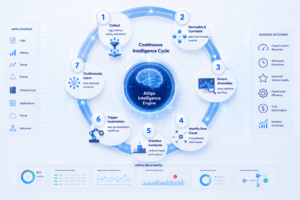
A modern AIOps platform follows a continuous intelligence cycle:
- Collect logs, metrics, traces, and events.
- Normalize and correlate data.
- Detect anomalies using machine learning.
- Identify probable root causes.
- Prioritize incidents.
- Trigger automated remediation workflows.
- Continuously learn from historical incidents.
This enables faster incident response with minimal manual intervention.
AIOps Monitoring: How It Differs from Traditional Monitoring
Traditional monitoring tools are built to watch individual systems and fire an alert when a threshold is crossed CPU spikes, disk fills up, a service goes down. Each tool typically works in isolation, which means IT teams end up stitching together dozens of dashboards and alert feeds by hand.
AIOps monitoring works differently. Instead of watching systems one at a time, it ingests telemetry logs, metrics, traces, and events from every monitoring source at once, then uses machine learning to understand what “normal” looks like across the whole environment. That makes it possible to:
- Catch anomalies that no single threshold-based alert would flag on its own
- Correlate related alerts from different systems into a single incident, instead of 40 separate tickets for one root cause
- Reduce false positives by learning normal behavior patterns over time, not just fixed thresholds
- Surface the handful of alerts that actually matter, out of the thousands generated daily
In short: traditional monitoring tells you something is wrong. AIOps monitoring tells you what’s wrong, why, and where to look first.
Key Benefits of an AIOps Solution
| Benefit | Business Impact |
| Intelligent Alert Correlation | Reduces alert noise and eliminates duplicates |
| Predictive Analytics | Prevents outages before they occur |
| Root Cause Analysis | Accelerates troubleshooting |
| Automated Remediation | Reduces manual effort |
| Performance Optimization | Improves service availability |
| Capacity Forecasting | Optimizes infrastructure investments |
Organizations implementing AI for IT Ops often experience:
- Faster incident detection
- Lower operational costs
- Higher infrastructure availability
- Better customer experience
- Reduced downtime
- Improved SLA compliance
AIOps Examples Across Industries
Here are some practical AIOps examples:
Banking Detect abnormal transaction infrastructure behavior before customers experience service disruption.
Healthcare Monitor hospital applications and critical infrastructure to ensure continuous availability.
Manufacturing Predict equipment failures using telemetry and sensor data.
Retail Handle seasonal traffic spikes while maintaining application performance.
Telecommunications Optimize network performance using Network AIOps for proactive fault detection.
Network AIOps Explained
Network AIOps applies AI-driven analytics specifically to enterprise networking. It helps organizations:
- Detect network anomalies
- Predict bandwidth bottlenecks
- Reduce false-positive alerts
- Automate fault isolation
- Improve Wi-Fi performance
- Optimize SD-WAN environments
As enterprise networks continue expanding across cloud and edge environments, Network AIOps has become a key component of digital transformation.
AIOps Predictive Analysis: Stopping Problems Before They Start
Most IT teams are used to operating in reactive mode — something breaks, a ticket gets filed, someone investigates. AIOps predictive analysis flips that model by using historical and real-time telemetry to forecast problems before they happen, not just detect them after the fact.
Here’s how it typically works:
- Pattern learning: the platform studies months of historical performance data to learn what precedes a failure — a slow memory leak, a gradually degrading disk, a recurring traffic pattern that overwhelms a service.
- Early warning signals: when current telemetry starts to resemble a known pre-failure pattern, the platform flags it well before a threshold-based alert would ever fire.
- Capacity forecasting: predictive models also project future resource needs, so infrastructure teams can scale ahead of demand instead of scrambling after an outage.
- Automated response triggers: in mature deployments, predictive alerts can kick off remediation workflows automatically — restarting a service, reallocating resources, or notifying the right team — before end users notice anything.
The payoff is straightforward: fewer 3 a.m. pages, fewer customer-facing outages, and infrastructure spend that’s based on forecasted need rather than guesswork.
AIOps Solution vs. AIOps Platform: What’s the Difference?
These two terms get used interchangeably, but if you’re evaluating vendors, the distinction matters.
What to Look for in an AIOps Solution
An AIOps solution typically refers to a more targeted implementation — a tool or capability set focused on solving a specific operational problem, such as alert correlation, anomaly detection, or root cause analysis for a defined part of your stack. Solutions are often faster to deploy and easier to evaluate in isolation, which makes them a good fit for teams tackling one clear pain point (e.g., “we need to cut alert noise” or “we need faster root cause analysis”).
What to Look for in an AIOps Platform
An AIOps platform is broader by design. It’s meant to be the central intelligence layer across your entire IT environment — ingesting data from every monitoring, observability, and ITSM tool you run, then applying machine learning across all of it. When evaluating a platform, look for:
- AI-powered anomaly detection across the full stack
- Event correlation and de-duplication
- Root cause analysis
- Predictive analytics and capacity forecasting
- Automated remediation workflows
- Cloud-native, scalable architecture
- Open API integrations
- ITSM integration (ServiceNow, Jira, etc.)
- Security monitoring support
The practical takeaway: if you’re solving one problem, a focused AIOps solution may get you there faster. If you’re trying to unify visibility and automation across a growing, hybrid environment, you need a full AIOps platform — one that scales with the complexity, rather than adding another isolated tool to the pile.
Choosing the Best AIOps Platform
When evaluating the best AIOps platform for your organization, weigh these capabilities against your current environment:
- AI-powered anomaly detection
- Event correlation
- Root cause analysis
- Predictive analytics
- Automated remediation
- Cloud-native monitoring
- API integrations
- ITSM integration
- Security monitoring support
- Scalability
A mature AI Ops platform should integrate seamlessly with existing monitoring, observability, ITSM, and automation tools — not require you to rip and replace everything you already run.
AIOps vs. Traditional Monitoring
Traditional monitoring tools are reactive by design: they alert you after a threshold is crossed. AIOps is proactive — it correlates signals across the environment, predicts problems before they escalate, and often resolves routine issues automatically. Most enterprises don’t fully replace traditional monitoring; they layer AIOps on top of it as an intelligence and automation layer.
AIOps vs. DevOps
AIOps and DevOps aren’t competing approaches — they’re complementary. DevOps is a culture and set of practices for building and shipping software faster. AIOps applies AI specifically to the operations side of that lifecycle, giving DevOps and SRE teams the visibility and automation needed to keep increasingly complex, fast-moving systems stable.
AIOps Market Trends and Statistics
The growing complexity of enterprise IT environments continues to drive rapid adoption of AIOps technologies.
| Market Insight | Trusted Source |
| Gartner predicts that AI-driven IT operations will become a core capability for enterprise observability platforms. | Gartner |
| IDC identifies AI-assisted operations as a major investment area for digital enterprises. | IDC FutureScape |
| Gartner reports that organizations are increasingly adopting AIOps to improve incident management and automation. | Gartner Hype Cycle |
| Gartner highlights growing demand for autonomous IT operations powered by AI and automation. | Gartner |
| Enterprises continue increasing investments in observability and AIOps as hybrid cloud environments expand. | IDC |
These trends point to a clear shift: organizations are moving from “AIOps as an experiment” to “AIOps as infrastructure.” As hybrid and multi-cloud environments keep expanding, the teams that adopt predictive, automated operations now will be the ones best positioned to handle the next wave of infrastructure complexity — rather than adding headcount to keep up with it.
Why AIOps Is the Future of IT Operations
As enterprise IT environments continue to grow in scale and complexity, relying solely on traditional monitoring tools is no longer enough. AIOps empowers organizations to move beyond reactive operations by combining artificial intelligence, machine learning, and automation to detect issues earlier, reduce alert fatigue, and accelerate incident resolution.
Whether you’re managing hybrid cloud infrastructure, optimizing network performance, or improving service reliability, a modern AIOps platform provides the intelligence needed to make faster, data-driven decisions. By adopting the right AIOps solution, businesses can enhance operational efficiency, reduce downtime, and deliver better digital experiences.
Ready to modernize your IT operations? Explore how an enterprise-grade AIOps platform can help your organization automate workflows, improve observability, and build a resilient, future-ready IT environment.

Ready to modernize your IT operations? Explore how an enterprise-grade AIOps platform can help your organization automate workflows, improve observability, and build a resilient, future-ready IT environment.
Must Read Articles:
- latest AI ITSM trends
- Why Virtual Support Agents Are Becoming the First Line of AI Service Desks
- Predictive Analysis in AIOps: How AI Stops IT Problems Before They Start
Frequently Asked Questions
What is AIOps?
AIOps stands for Artificial Intelligence for IT Operations and uses AI, machine learning, and automation to improve IT operations.
What is an AIOps platform?
An AIOps platform collects operational data, detects anomalies, correlates events, identifies root causes, and automates incident response.
What is AI for IT Ops?
It refers to applying artificial intelligence to monitor, analyze, and optimize IT infrastructure and applications.
Is Network AIOps different?
Yes. Network AIOps focuses specifically on network infrastructure, enabling proactive monitoring, anomaly detection, and performance optimization.
What’s the difference between an AIOps solution and an AIOps platform?
An AIOps solution is typically a focused tool addressing one operational problem, like alert correlation or root cause analysis. An AIOps platform is a broader, central intelligence layer that unifies data and automation across your entire IT environment.
What is AIOps monitoring?
AIOps monitoring uses machine learning to analyze telemetry from every monitoring source at once, correlating related alerts and learning normal behavior patterns instead of relying on isolated, threshold-based alerts from individual tools.