Your IT team probably knows how many laptops are deployed, which servers run critical applications, and where your major network devices are located. But what about cloud instances created last month, software installed outside procurement processes, or devices sitting at remote offices?
This is the reality of growing IT operations in 2026 — and it is exactly the problem that IT asset management tools exists to solve.
This visibility gap is becoming harder to manage as organizations operate across on-premise data centers, cloud platforms, remote offices, and distributed work environments. IT asset management tools help organizations bring this information together, providing a structured way to discover, track, manage, and govern IT assets throughout their lifecycle.
Modern ITAM is no longer just about maintaining an inventory. It is becoming an important part of IT operations management, security, compliance, financial control, and service delivery.
What Are IT Asset Management Tools and Why Do They Matter?
IT asset management tools help organizations maintain visibility and control over hardware, software, licenses, contracts, and other technology assets.
Traditional asset registers often depend on spreadsheets, manual audits, or information maintained separately by different teams. Modern ITAM platforms can automate discovery, centralize asset information, track changes, and connect asset data with other IT operations.
The global ITAM software market was valued at over $2.2 billion in 2024 and is projected to reach $4.1 billion by 2033, growing at a CAGR of 7.11%. The driver is not just growth — it is complexity. Hybrid work, cloud migration, SaaS proliferation, and distributed infrastructure have made manual asset tracking not just inefficient but genuinely dangerous.
Key Takeaway: Fewer than 30% of enterprise organizations have complete, real-time visibility into their hybrid IT estates — exposing them to unbudgeted cloud spend, software audit penalties, and security blind spots. (Flexera State of ITAM Report, 2025)
Core Functions of ITAM Tools
A modern IT asset management software platform does far more than maintain a list of devices. It:
- Discovers assets automatically across on-premises, cloud, and hybrid environments
- Tracks the full asset lifecycle from procurement through deployment, maintenance, and retirement
- Manages software licenses to prevent compliance violations and eliminate wasted spend
- Maps asset dependencies so teams understand what connects to what
- Integrates with ITSM and monitoring tools to connect assets to live operational context
The Hybrid Infrastructure Problem
Modern infrastructure rarely exists in one location.
Organizations may operate across:
| Environment | Typical Assets |
| On-premises | Servers, switches, storage, desktops |
| Private cloud | Virtual machines, applications, databases |
| Public cloud | Instances, storage, managed services |
| Branch offices | Routers, switches, endpoints |
| Remote workforce | Laptops, mobile devices, SaaS applications |
| Edge environments | Edge devices, sensors, network equipment |
This creates a major challenge for IT inventory management.
Assets can be created, moved, upgraded, reassigned, or retired without the central asset register being updated immediately. Cloud resources can also change much faster than traditional physical infrastructure.
IT Asset Tracking Across Hybrid Cloud Infrastructure
The challenge with hybrid cloud infrastructure is not only the number of assets. It is the rate at which those assets change.
A traditional periodic audit might identify what existed several months ago. Modern IT teams need visibility into what exists now.
Effective IT asset tracking should therefore answer questions such as:
- What assets currently exist?
- Where are they located?
- Who owns them?
- What software is installed?
- Which assets are approaching end of life?
- Which services depend on them?
- Have they recently changed?
This is where automated discovery and centralized ITAM become valuable.
Asset Lifecycle Management: From Procurement to Retirement
An asset should not disappear from an organization’s records once it is deployed.
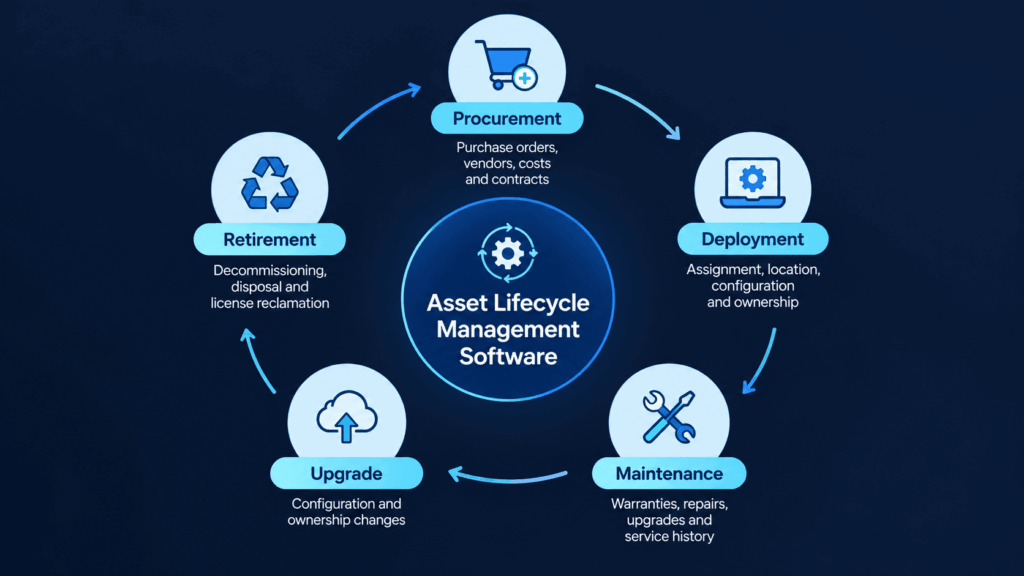
Asset lifecycle management covers the complete journey of an IT asset:
Procurement → Deployment → Utilization → Maintenance → Upgrade → Retirement
What Asset Lifecycle Management Software Should Do
Effective asset lifecycle management software should help organizations manage:
- Procurement — purchase orders, vendors, costs, and contracts
- Deployment — assignment, location, configuration, and ownership
- Maintenance — warranties, repairs, upgrades, and service history
- Change management — configuration and ownership changes
- Renewal — contracts, licenses, warranties, and subscriptions
- Retirement — decommissioning, disposal, and license reclamation
This gives IT teams a complete historical record instead of disconnected snapshots.
It also supports IT asset management best practices by making lifecycle information easier to maintain and audit.
CMDB and IT Asset Management: Connecting the Pieces
An asset inventory tells you what you have.
A configuration management database (CMDB) helps explain how those assets relate to each other and the services they support.
For example, a CMDB can help establish relationships between:
Server → Application → Database → Network → Business Service
What Is a Configuration Management Database?
A configuration management database stores information about configuration items and their relationships.
This relationship information becomes particularly useful during incidents.
Imagine a critical application becomes unavailable. A basic inventory might tell you which servers exist. A CMDB can provide additional context about the server, its connected network devices, applications, dependencies, and services.
CMDB Asset Management Works Better With Live Data
CMDB asset management becomes significantly more useful when asset information is continuously updated.
When discovery, ITAM, and CMDB capabilities work together:
Discover → Update → Map Relationships → Monitor → Investigate
This creates a more current operational view of the infrastructure.
Why IT Asset Management Tools Must Connect to IT Operations
Asset information becomes much more valuable when it is connected to the systems that IT teams use every day.
Connecting Assets With Network Monitoring Tools
Network monitoring tools can detect availability, performance, latency, bandwidth, and device-related issues.
When monitoring and ITAM are connected, an alert can carry additional asset context.
Instead of simply seeing:
“Network device unreachable.”
An operations team can potentially see:
- Device identity
- Location
- Asset owner
- Configuration information
- Related services
- Historical changes
- SLA information
This reduces the need to manually search through multiple systems during an incident.
IT Ticketing System and Asset Management
The same principle applies to service management.
When an incident is linked automatically to the affected asset, the service desk receives more context at the beginning of the investigation.
This can help teams understand:
- Which asset is affected
- Who owns it
- What changed recently
- Whether it is under warranty
- Which services depend on it
- Whether similar incidents occurred previously
Connected ITAM and ITSM can therefore support faster investigation and more informed incident management.
How IT Asset Management Tools Support IT Operations Management
ITAM should not operate as an isolated administrative function.
For modern organizations, asset information can support multiple operational teams:
| IT Function | How Data Asset helps |
| IT Operations | Infrastructure visibility |
| Service Desk | Faster incident context |
| Security | Asset discovery and ownership |
| Procurement | Purchasing and vendor decisions |
| Finance | Cost and asset lifecycle visibility |
| Compliance | Audit and governance |
| NOC | Device and network context |
| Management | Infrastructure reporting |
This is why ITAM has increasingly become part of broader IT operations management.
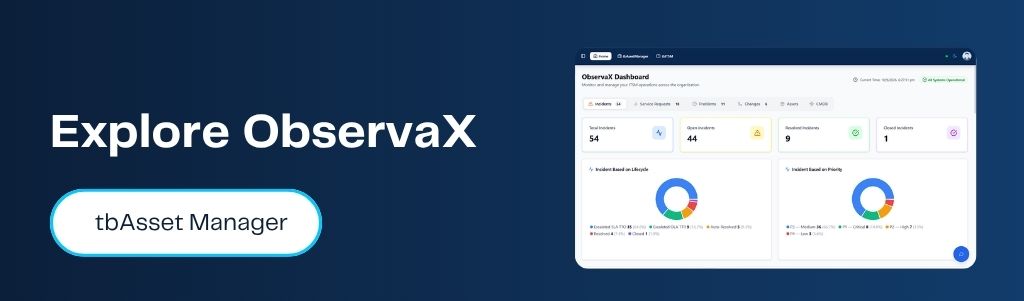
How ObservaX tbAssetManager Supports Modern ITAM
ObservaX tbAssetManager is designed to provide centralized asset intelligence across distributed IT environments.
It supports organizations in managing assets from discovery through retirement while connecting asset information with broader operational workflows.
Key capabilities include:
- Automated asset discovery across IT environments
- IT asset inventory management for hardware, software, licenses, contracts, and related information
- Asset lifecycle management from procurement to retirement
- CMDB integration for asset relationships and operational context
- ITSM integration to connect assets with incidents and service requests
- Integration with network monitoring tools
- SLA and service context
- Historical asset and configuration information
- Reporting and governance capabilities
This connected approach allows IT teams to move beyond maintaining an inventory toward managing assets as part of the broader operational environment.
What Should You Look for in IT Asset Management Tools?
When evaluating ITAM platforms, organizations should consider more than basic inventory capabilities.
Look for:
- Automated discovery
- Hardware and software tracking
- IT asset tracking
- Lifecycle management
- License management
- Contract and warranty tracking
- CMDB integration
- ITSM integration
- Network monitoring integration
- Reporting and analytics
- Role-based access
- Audit history
- Support for hybrid infrastructure
- Scalability across distributed environments
The right platform should fit into existing IT operations rather than becoming another isolated database.
Must Read Articles:
Why Network Monitoring Alone Isn’t Enough: Building a Digital Command Center
IT Asset Management Software: Features, Benefits & Complete Guide
AI Network Monitoring: How Government and Critical Infrastructure NOCs Are Modernizing with AIOps
As infrastructure becomes more distributed, maintaining an accurate asset inventory is becoming increasingly difficult. IT asset management tools provide a structured way to bring hardware, software, lifecycle, configuration, and operational information together.
The real value comes when ITAM connects with CMDB, ITSM, network monitoring, and other operational systems. This turns asset information from a static inventory into useful operational context.
For organizations managing hybrid infrastructure, modern ITAM can support better visibility, stronger governance, more informed decision-making, and more connected IT operations.
FAQs About IT Asset Management Tools
What are IT asset management tools?
Why are IT asset management tools important for hybrid infrastructure?
What is the difference between ITAM and a CMDB?
What is IT asset tracking?
What should organizations look for in IT asset management tools?