Network monitoring software helps IT teams continuously monitor the health, availability, performance, and traffic of their network infrastructure. As organizations operate increasingly distributed networks across offices, data centers, cloud environments, and remote locations, maintaining real-time visibility has become essential.
The importance of network monitoring is also increasing as network environments become more complex. The 2025 EMA Network Observability Maturity Model research found that 87% of teams struggle with observability tool sprawl, while only 52% reported being completely successful with network observability. The same research found that just 29% of alerts were considered actionable, highlighting the challenge of managing monitoring noise.
Traditional approaches that rely on manual troubleshooting or disconnected monitoring tools can make it difficult to identify performance issues before they affect users. Modern network monitoring combines centralized dashboards, automated alerts, performance metrics, traffic visibility, and AI-driven analysis to help IT teams detect and respond to issues faster.
What Is Network Monitoring?
Network monitoring is the continuous process of observing network devices, connections, traffic, and performance metrics to identify availability, performance, and operational issues.
A network monitoring platform can collect information from:
- Routers
- Switches
- Firewalls
- Servers
- Wireless devices
- WAN links
- Network interfaces
- Data center infrastructure
Monitoring metrics such as bandwidth utilization, latency, packet loss, CPU usage, memory utilization, and device availability helps IT teams understand whether the network is operating normally.
Modern monitoring can also establish performance baselines and identify deviations from expected behaviour, helping teams detect problems before they significantly affect users.
How Does Network Monitoring Software Work?
Network monitoring software collects telemetry and performance information from network infrastructure and presents it through centralized dashboards, reports, and alerts.
A typical monitoring process includes:
Discover → Collect → Analyze → Alert → Investigate → Resolve
Network Discovery
Automated discovery identifies network devices and infrastructure that need to be monitored.
This gives IT teams a clearer view of what is connected to the network and helps keep monitoring coverage up to date.
Performance Data Collection
Monitoring tools collect metrics from network devices and interfaces to understand availability and performance.
Depending on the platform, monitoring can use technologies such as SNMP, syslog, and flow-based data sources.
Alerting and Notifications
When a monitored metric crosses a defined threshold or deviates from normal behavior, the platform can generate an alert.
This allows network teams to investigate potential issues before they become major service disruptions.
Key Features of Network Monitoring Software
Modern network monitoring tools provide capabilities designed to improve visibility and reduce manual troubleshooting.
Real-Time Network Monitoring
Real-time network monitoring provides continuous visibility into device health, availability, bandwidth, latency, and other performance indicators.
This helps network teams identify issues as they occur rather than relying only on periodic reports.
Network Performance Monitoring
Network performance monitoring focuses on understanding how effectively the network is delivering connectivity and services.
Common metrics include:
- Latency
- Packet loss
- Bandwidth utilization
- Throughput
- Interface errors
- Device availability
- CPU and memory utilization
Tracking these metrics helps teams identify bottlenecks and performance degradation.
Network Traffic Monitoring and Analysis
A network traffic monitor helps teams understand how bandwidth and traffic are being consumed across the environment.
A network traffic analyzer can provide additional visibility into traffic patterns, heavy usage, unusual flows, and potential bottlenecks.
This information can support capacity planning and troubleshooting.
Network Topology and Visibility
Network maps and topology views help teams understand device relationships and connectivity.
When an issue occurs, topology information can provide useful context about which devices, links, or services may be affected.
Alerts and Notifications
Effective monitoring platforms allow teams to define thresholds, severity levels, notifications, and escalation workflows.
The objective isn’t simply to generate more alerts. It is to surface the alerts that require attention while reducing unnecessary noise.
This is particularly important given the 2025 EMA finding that only 29% of alerts were considered actionable among the organizations surveyed.
Historical Reporting and Analytics
Historical performance data allows teams to identify trends, compare performance over time, plan capacity, and investigate recurring issues.
What Are the Benefits of Network Monitoring?
Organizations use network monitoring solutions to improve both day-to-day operations and long-term infrastructure planning.
Improved Network Visibility
Centralized dashboards give network teams a consolidated view of devices, links, traffic, and performance.
Faster Troubleshooting
When performance data and alerts are available in one place, engineers can investigate issues more efficiently.
Reduced Downtime
Early detection allows teams to address potential problems before they develop into significant outages.
The financial impact can be substantial. Splunk’s 2026 Hidden Costs of Downtime research reports that companies lose an average of $300 million per year to unplanned outages, while 43% of downtime events were network- or IT-environment-related in its survey.
That makes proactive monitoring more than an operational convenience—it can be part of a broader business resilience strategy.
Better Capacity Planning
Historical bandwidth and utilization data helps organizations understand growth patterns and determine when additional capacity may be required.
Improved User Experience
Network performance directly affects applications and services. Monitoring latency, packet loss, availability, and throughput can help teams identify problems that impact users.
AI Network Monitoring: The Next Step in Network Operations
Traditional monitoring typically relies on predefined thresholds and rules. While these remain useful, modern environments can generate too much data and complexity for manual analysis alone.
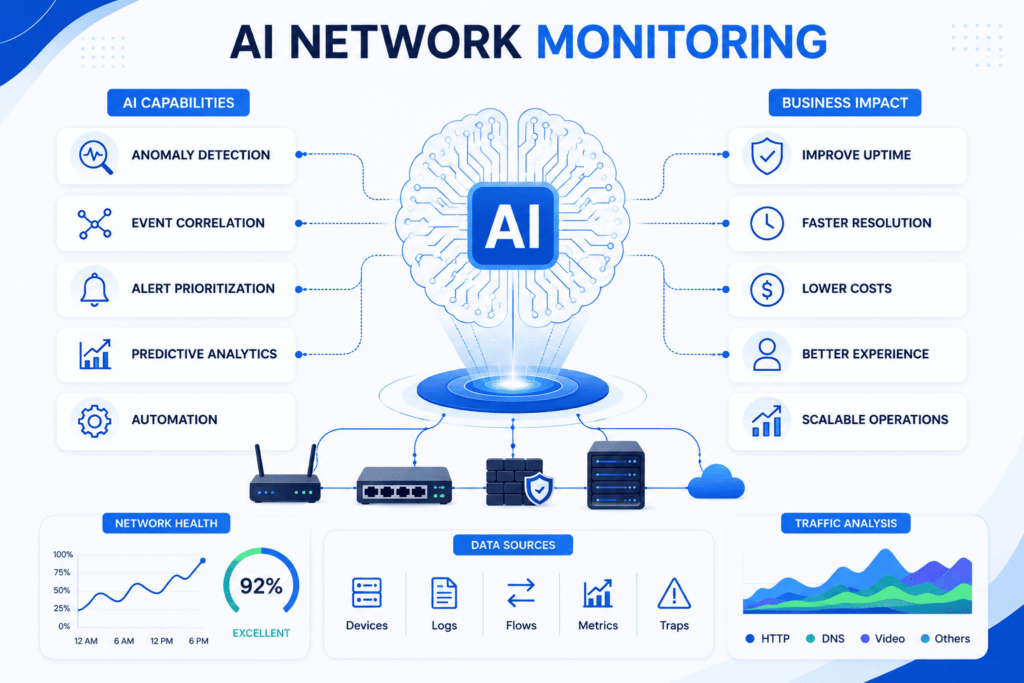
AI network monitoring uses AI and machine learning to analyze network telemetry, identify anomalies, correlate events, and help prioritize issues.
Potential applications include:
- Anomaly detection
- Dynamic performance baselines
- Event correlation
- Alert prioritization
- Predictive analysis
- Root cause analysis
- Automated ticket creation
- Network optimization
Recent research also shows growing interest in generative AI for network monitoring and management, including traffic classification, log analysis, intrusion detection, and networked-system assistance.
AI-powered network management is also becoming increasingly relevant as networks handle more complex workloads. Recent industry reporting highlights AI and automation as ways to reduce manual monitoring, analyze network data in real time, and improve anomaly detection.
However, AI should complement network engineers rather than remove human oversight. Critical network decisions still require appropriate validation, governance, and control.
NOC Monitoring and Network Operations
NOC monitoring is an important use case for network monitoring software.
Network Operations Centers need continuous visibility into infrastructure health and service availability. A centralized monitoring platform can help NOC teams:
- Monitor devices across multiple locations
- Prioritize critical alerts
- Identify network degradation
- Track SLA-related performance
- Investigate recurring incidents
- Escalate issues to appropriate teams
- Review historical network performance
For large environments, combining monitoring, alert correlation, automation, and centralized dashboards can help NOC teams manage network operations more efficiently.
Also Read: Why Do Businesses Need the Best NOC Tools?
How to Choose the Best Network Monitoring Tools
The best network monitoring tools depend on the organization’s infrastructure, scale, monitoring requirements, and operational processes.
Before selecting a platform, evaluate:
Device coverage — Does it support the devices and technologies in your environment?
Real-time visibility — Can teams monitor network health continuously?
Performance monitoring — Does it track relevant network metrics?
Traffic analysis — Can it provide visibility into bandwidth and traffic patterns?
Alerting — Can teams customize thresholds, severity, and notifications?
Topology — Does it provide useful network maps and relationships?
Automation and AI — Can it reduce manual investigation and alert handling?
Integrations — Can it connect with ITSM and other operational systems?
Scalability — Can it support future infrastructure growth?
Free network monitoring tools can be useful for small environments or testing, but enterprises should evaluate scalability, automation, reporting, integrations, support, and security before selecting a platform for production operations.
Why Network Observability Is Becoming Important
Network monitoring traditionally focuses on whether devices and connections are available and performing within defined thresholds.
Network observability goes further by helping teams understand why something is happening across complex environments.
The distinction is increasingly relevant as organizations manage hybrid infrastructure, cloud environments, distributed applications, and increasingly dynamic network traffic.
The 2025 EMA research found that 87% of organizations surveyed were using multiple network observability tools, highlighting the problem of tool sprawl. It also found that organizations integrating their tools deeply were four times more likely to report complete success with network observability.
This suggests an important direction for IT teams: instead of continuously adding monitoring products, organizations can benefit from platforms that bring more operational context together.
ObservaX tbXMS for Network Monitoring
Modern enterprises need more than isolated device monitoring. They need a unified view of network health, performance, events, infrastructure relationships, and operational impact.
tbXMS from ObservaX is designed to provide centralized network monitoring and management capabilities for enterprise IT environments.
With tbXMS, IT and network teams can gain visibility into:
- Network device availability
- Device performance
- Bandwidth utilization
- Latency and performance metrics
- Faults and events
- Alerts and notifications
- Network topology
- Historical performance trends
- Multi-vendor infrastructure
The platform can help teams move from reactive troubleshooting toward more proactive network operations by bringing monitoring data, alerts, performance information, and infrastructure context together.
More importantly, tbXMS can work as part of the broader ObservaX unified IT operations platform, connecting network monitoring with capabilities such as IT service management, configuration management, SLA management, application performance monitoring, asset management, and traffic analysis.
This creates a connected operational workflow:
Network Monitoring → Event Detection → Alert → ITSM → Configuration/Asset Context → Resolution
For organizations looking to reduce monitoring silos and improve visibility across complex IT environments, tbXMS provides network monitoring as part of a broader unified operations approach.
Also Read: IT Asset Management Software: Features, Benefits & Complete Guide
Also Read: The Future of AI IT Service Management: 5 Trends Defining 2026
Frequently Asked Questions About Network Monitoring
What is network monitoring?
What is network monitoring software?
What are the best network monitoring tools?
What is AI network monitoring?
What is a network traffic analyzer?
Sources & Research: Industry statistics and research referenced in this article are based on the 2025 EMA Network Observability Maturity Model research and Splunk’s 2026 Hidden Costs of Downtime research. Additional context on AI-driven network monitoring is informed by recent industry and academic research.